
Impersonating your brand online is easier than most teams expect. Attackers can send spoofed emails using your domain, trick customers, and damage trust across sales, support, and reputation.
Many companies invest in web application security while overlooking DNS and email authentication. Missing or weak SPF, DKIM, and DMARC records leave a clear opening for attackers.
Guardbee detects these gaps automatically so you can protect your digital identity.
What is DNS and email security?
A domain is not only your website address. It is also the identity behind email sent on your company’s behalf.
Misconfigured DNS records can lead to:
- Spoofed outbound email
- Phishing attacks
- Landing on spam blocklists
- Failed email delivery
- Brand reputation damage
That is why DNS security is a company-wide priority, not only an IT checklist item.
What does Guardbee check?
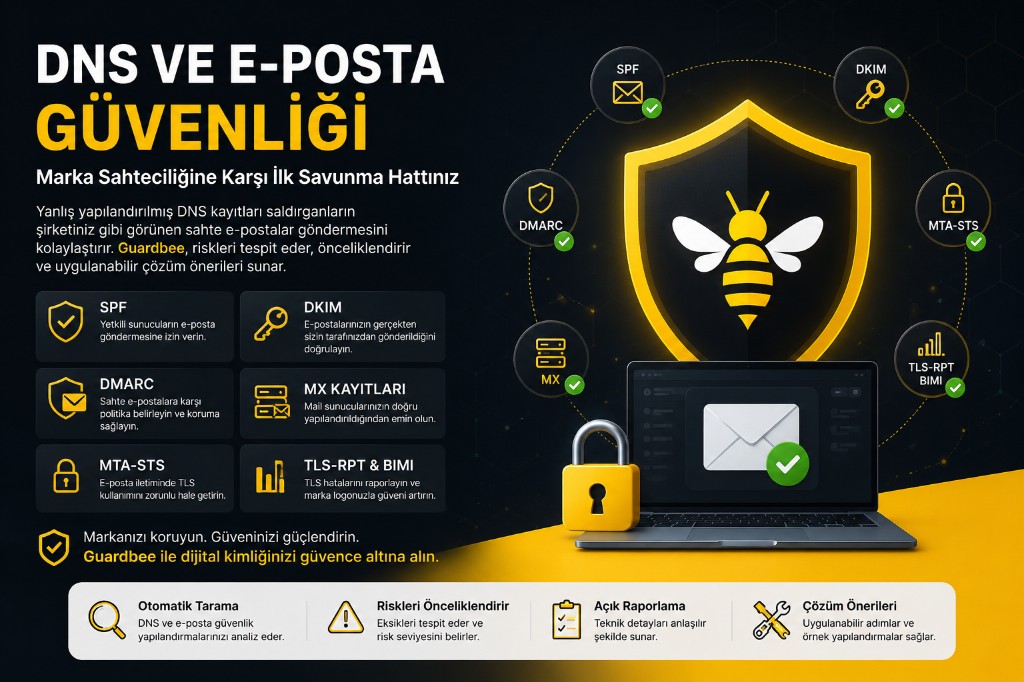
Guardbee scans your domain and analyzes critical email security configuration.
SPF records
SPF (Sender Policy Framework) defines which servers may send mail for your domain. Missing or incorrect SPF makes spoofing easier.
Guardbee checks whether SPF exists, whether syntax is valid, whether lookup limits are exceeded, and whether risky configurations appear.
DKIM
DKIM cryptographically verifies that a message really came from your mail infrastructure. Guardbee detects DKIM records, reports missing keys, and flags misconfigurations.
DMARC
DMARC uses SPF and DKIM outcomes to decide how receivers should treat spoofed mail — for example none, quarantine, or reject. Domains without DMARC remain highly exposed to phishing. Guardbee reports this gap directly.
MX records
Guardbee checks MX records, priorities, and broken routing that can affect mail delivery and security posture.
MTA-STS
MTA-STS helps enforce TLS for SMTP delivery. Without it, attackers may attempt to downgrade secure connections in some scenarios. Guardbee analyzes MTA-STS support.
TLS-RPT
TLS-RPT reports TLS delivery failures. Guardbee checks whether the record is present.
BIMI
BIMI can display your brand logo in supported clients and often signals email-security maturity. Guardbee analyzes BIMI configuration.
How Guardbee does it
Guardbee runs a fully passive analysis with no agent install. During the scan it analyzes DNS records, reviews authentication mechanisms, identifies missing standards, calculates risk, explains findings in plain language, and prepares remediation steps.
Why it matters
If an attacker can email your customers using your domain, you can lose trust, enable fraud, damage brand reputation, and hurt deliverability. Much of this risk is preventable with correct DNS configuration.
Conclusion
A secure website alone is not enough. Domain email security is just as critical as application security.
Guardbee analyzes DNS and email-security configuration in seconds, surfaces gaps, prioritizes risk, and proposes actionable fixes — so you can protect your brand beyond the web app, in email traffic too.
Protect your brand — scan SPF, DKIM, DMARC and related DNS signals.
Get started free Log in Features →